
Saturday morning in South Austin. The kids are already awake. The cooler is packed, the RZR is in the driveway, and someone has just realized — with genuine horror — that there is no way to get that machine to Hidden Falls without a trailer. You start texting around. Half your friends with big trucks are already on their way somewhere. The other half say “yeah, I have a trailer” and then describe a 5×8 utility that your Maverick X3 would embarrassingly overflow.
This happens every weekend across the Austin metro, from Zilker to Pflugerville. The solution is straightforward once you know which trailer to rent, how to load it right, and what Texas law expects of you on the way out Hwy 71. Here is everything you need to know.
Choosing the Right Trailer for Your Machine
The single biggest mistake first-time ATV haulers make is grabbing the smallest available trailer and assuming the machine will fit. Fit is only part of the equation. The other part is ramp geometry — and it matters a lot for wide or low-clearance machines.
Utility trailer
A standard utility trailer works well for a single ATV or a narrower side-by-side that fits within the deck width with room to spare for tie-down rigging. If you’re hauling one machine — a Yamaha Grizzly, a Polaris Sportsman, a Can-Am Outlander — and it weighs under roughly 1,200 to 1,500 lbs, the utility trailer gets you there without overthinking it. You’ll want to verify the deck length is sufficient for your wheelbase, and confirm the ramp angle isn’t so steep that you’re bottoming out the rear skidplate on the way up.
Deckover trailer with mega ramps
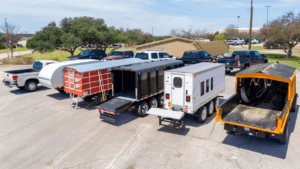
This is where the deckover with mega ramps changes the game. A standard deckover sits its deck over the fender wells, giving you a full-width platform — up to the legal 102-inch maximum under Texas Transportation Code §621.201. Wide machines like a Polaris RZR Pro R, a Can-Am Maverick X3 Max, or a full-cab Yamaha Wolverine X4 need that width. They also need ramps that are wide enough that the outer tires don’t walk off the ramp edge during loading. Mega ramps solve the pinch-point problem that standard ramps create on machines over 60 to 64 inches wide. If you’ve ever watched someone’s RZR nearly tip sideways on a narrow ramp, you understand why the extra ramp width is not a luxury.
Two smaller machines or mixed loads
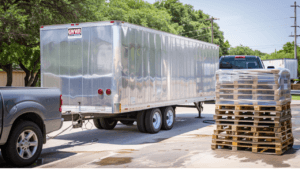
Hauling two ATVs, or a side-by-side plus a motorcycle, calls for a deckover as well — both for deck area and for weight capacity. Two mid-size ATVs (say, two Yamaha Grizzly 700s at around 700 lbs each) put you at 1,400 lbs of machines before you add fuel, gear bags, and any accessories. The deckover’s rated capacity handles this where a utility trailer might not.
Know Your Rig’s Tow Rating Before You Hitch
Not all trucks are equal on a load. The 2025 F-150 with the Max Tow package is rated up to 13,500 lbs, but the truck you actually drove off the lot may be rated considerably less depending on engine and axle configuration — and the real limiting factor for most half-ton owners is payload, not the tow rating number on the sticker. Payload typically runs 1,500 to 2,000 lbs on a half-ton pickup. Once you load passengers, gear, fuel, and the tongue weight of the trailer, you are often operating closer to your payload ceiling than you’d expect.
For an ATV load, this is rarely the limiting issue — a utility trailer plus one ATV is typically well under 3,000 lbs total — but when you step up to a full-width side-by-side on a deckover, you want to know where your truck actually stands. Check the door jamb sticker, not the commercial on television.
You’ll also want a Class III hitch at minimum (rated to 8,000 lbs gross trailer weight in weight-carrying mode) for any of the deckovers, and a brake controller in the cab if the trailer is equipped with electric brakes.
Texas Law on the Way Out Hwy 71
Brakes and your brake controller
Under Texas Transportation Code §547.401, any trailer with a gross weight over 4,500 lbs must be equipped with brakes. A deckover trailer loaded with a full-size side-by-side can easily clear that threshold — a Polaris RZR Pro R alone weighs around 2,000 lbs, and the trailer itself adds its own weight. If the trailer has electric brakes, those brakes do nothing without a functioning brake controller in your truck’s cab. Confirm your truck has one before you roll.
Safety chains — cross them
Texas Transportation Code §545.410 requires two safety chains attached from the trailer to the tow vehicle on any passenger car or light truck towing a trailer. The DPS implementing rules under 37 TAC §21.5 specify that those chains must be crisscrossed under the tongue — not looped through loosely or run parallel. The crossed configuration catches the tongue if the coupler separates, preventing it from digging into the pavement. Lock-latch hooks only; open S-hooks are not acceptable.
Speed
Texas does not impose a lower speed limit for towing standard rental trailers. The posted limit is your limit. On Hwy 71 west toward Bee Cave and Spicewood, that is typically 70 mph on the open stretches, dropping through towns. Drive smoothly — trailers loaded with tall side-by-sides have a higher center of gravity than an empty flatbed, and quick lane changes at highway speed can create sway that compounds fast.
The Route: Austin to Hidden Falls and Beyond
Hidden Falls Adventure Park (Marble Falls area)
The most popular ATV destination within easy reach of Austin is Hidden Falls Adventure Park near Marble Falls, about 50 miles west of downtown. From South Austin, you’re heading out Hwy 71 west through Bee Cave and Spicewood, then picking up RM 962 north toward Marble Falls. The route is largely two-lane Hill Country road by the time you reach RM 962, so take the curves easy with a loaded deckover — not because Texas law requires you to slow down, but because a 10,000-lb combination takes significantly more stopping distance than a solo truck.
Pace Bend and the Lake Travis corridor
Pace Bend Park on Lake Travis is another popular weekend destination for riders and campers hauling watercraft alongside their ATVs. You’re on RM 2322 from Spicewood, and the road gets winding in the final stretch. Trailers with tall machines need patience on switchbacks.
RM 1431 and the Marble Falls corridor
If you’re heading to a ranch or private property north and west of Marble Falls, RM 1431 west from Cedar Park through Lago Vista out to Marble Falls is a common route. It’s faster than RM 2222 once you’re past Cedar Park.
Pedernales Falls State Park
Pedernales Falls is south of Johnson City, roughly 50 miles west via Hwy 290 west out of Oak Hill. ATVs are not permitted in the state park itself, but the area is ringed by private ranches and riding properties. Many Austinites trailer machines here for ranch access. Watch the Pedernales River crossing roads after rain — water levels change quickly.
Loading and Securing Your Machine
Getting the machine on the trailer right is at least as important as choosing the right trailer. Here is a practical checklist:
- Back the trailer onto level ground before loading. A cross-slope on the loading approach creates lateral instability at the top of the ramp.
- Drive slowly up the ramps. On a deckover with mega ramps, the ramp angle is gentler than on standard equipment trailers, but momentum can still carry a machine into the front rail if you don’t brake early.
- Center the machine fore-to-aft on the deck. Tongue weight should land in the 10–15% range of the total loaded trailer weight. Too much machine weight toward the rear creates trailer sway; too much forward weight overloads the hitch.
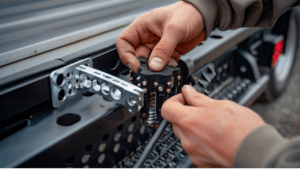
- Use four-point ratchet tie-down straps as a minimum. Run straps from the front left and front right suspension/frame points to the trailer’s front tie-down rings, then rear left and rear right. Pull snug but not so tight you compress suspension travel. Soft loops protect powder-coated or anodized surfaces better than bare hooks.
- Secure the ramps before moving. Stowed mega ramps that aren’t latched can shift during transport.
- Walk the load. Before you pull onto Hwy 71, get out and physically check that every strap is tight, every hook is seated, and the machine hasn’t shifted.
One More Thing Before You Leave Town
Check your trailer’s electrical connection — tail lights, brake lights, and turn signals — before you leave the lot. Texas requires taillamps visible at 1,000 feet and stoplamps visible at 300 feet (Texas Transportation Code §§547.322 and 547.323). A burned bulb on the left tail light is an easy fix in the parking lot and an unnecessary traffic stop on RM 962 when you’re 20 minutes from the trailhead.
Ready to Load Up This Weekend?
Texas Pro Trailers keeps both a utility trailer and a deckover with mega ramps ready to grab any time — no phone call, no waiting on staff to show up. Book online, get your access PIN, and swing by 7511 Dee Gabriel Collins Rd in South Austin. You’re just off Hwy 71/Ben White, which puts you directly on the route west toward the Hill Country. Pull in, unlock the keypad, hook up, and head out whenever you’re ready — 6 a.m. Friday morning or 10 p.m. Thursday night, it works the same way.