
It is late February in South Austin. You have priced out mulch at a couple of local suppliers, your landscaping beds are bare after a rough winter, and someone told you to just rent a dump trailer and haul your own rather than paying the delivery surcharge. Smart idea. But now you are wondering: will one trailer load actually cover your whole yard? And what if you switch to topsoil or decomposed granite — does the math change?
Yes, it changes dramatically. Here is everything you need to know before you load a single cubic yard.
The Baseline: What a 14-Foot Hydraulic Dump Trailer Holds
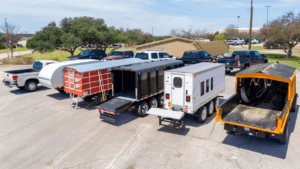
Texas Pro Trailers’ hydraulic dump trailer is a 14-foot bed with a heaped capacity of approximately 10 to 12 cubic yards. That is the volume figure — how much space the bed has.
But volume is only half the story. The trailer also has a gross vehicle weight rating (GVWR) that limits how much the loaded trailer can weigh. Every material you haul has a different density, which means the same cubic yard of mulch weighs very differently than a cubic yard of gravel.
The question “how many yards fit?” always has two answers:
- Volume limit — the physical space available in the bed
- Weight limit — what the trailer’s GVWR allows
Whichever limit you hit first is your real limit. Understanding this before you pull up to the pile at the landscape supplier will save you a failed load and a frustrated supplier operator.
Material-by-Material Breakdown
Mulch — Volume Is Usually the Limit
Mulch is light. Shredded hardwood mulch typically runs 400 to 800 pounds per cubic yard depending on moisture content and material type. Cedar mulch tends toward the lighter end; pine and hardwood mixes can run heavier, especially after rain.
At 600 pounds per cubic yard (a middle-ground estimate), a 10-yard load of mulch weighs about 6,000 pounds of material. Add the trailer’s own empty weight — typically around 7,000 to 8,000 pounds for a loaded 14-foot hydraulic dump — and your combined gross weight is well within the GVWR for a properly rated dump trailer.
What this means for you: With mulch, the volume of the trailer bed is usually the binding constraint, not the weight. You can heap mulch generously. A heaped 14-foot trailer holds enough mulch to cover:
| Desired Depth | Approximate Coverage from 10 Cubic Yards |
| 2 inches deep | ~1,620 square feet |
| 3 inches deep (recommended) | ~1,080 square feet |
| 4 inches deep | ~810 square feet |
A typical Austin quarter-acre residential lot with established beds along the front, back, and side yard fences might have 1,500 to 2,500 square feet of bed area. One full trailer load of mulch at 3 inches deep covers the smaller end of that range comfortably. For larger yards, plan for two trips.
Topsoil — Now Weight Is the Limit
This is where renters get surprised. Topsoil is dense. Dry topsoil runs about 2,200 pounds per cubic yard. Moist topsoil runs heavier — easily 2,700 pounds per cubic yard after Central Texas spring rains.
At 2,200 pounds per yard and a 10-yard load, you are looking at 22,000 pounds of topsoil alone — far beyond what any light-duty or standard dump trailer can legally carry. Even with a higher GVWR dump trailer, you are constrained by your tow vehicle’s payload capacity long before you hit the trailer’s structural limit.
A half-ton truck — F-150, Silverado 1500, Ram 1500 — typically has a payload capacity of 1,500 to 2,000 pounds (check your door sticker for the exact number; it varies by configuration). Tongue weight (the downward force on your hitch ball) runs 10 to 15 percent of the total loaded trailer weight by industry standard. You do not have unlimited margin.
The practical rule for topsoil in a 14-foot dump trailer: Load to approximately 4 to 5 cubic yards maximum and know your truck’s payload before you arrive at the yard. At 4 yards of moist topsoil, you are already pushing 10,000+ pounds of material. That is a real load your half-ton needs to handle, plus the trailer’s own weight.
Decomposed Granite and Gravel — Load by the Third
Gravel and decomposed granite are the heaviest common landscaping materials. Pea gravel, crushed limestone, and decomposed granite run 2,700 to 3,200 pounds per cubic yard, and in Central Texas, decomposed granite (DG) is one of the most popular path and bed materials going.
For gravel and DG, the rule of thumb is: load to roughly one-third of the trailer’s volume capacity by weight limits. That means 3 to 4 cubic yards in a 14-foot trailer — just enough to keep the gross load within a safe range for your truck’s payload.
If your project calls for significant gravel coverage, budget for multiple trailer runs or consider supplementing with delivered bulk material for the heavy-hauling portion.
Brush, Tree Limbs, and Yard Debris — Volume Is Everything
Light organic debris — branches, clippings, leaves, small limbs — weighs almost nothing relative to its volume. A heaped 14-foot trailer of brush might weigh 2,000 to 3,000 pounds total. Weight is never the concern here. Volume is. The good news: you can fill the trailer generously and not worry about overloading your truck.
A Summary Table
| Material | Approx. Weight per Cubic Yard | Max Safe Load (14-ft trailer) | Notes |
| Hardwood mulch (dry) | 400–600 lbs | 10–12 cu yds (heaped) | Volume is the limit |
| Hardwood mulch (wet) | 700–900 lbs | 8–10 cu yds | Weigh more after rain |
| Dry topsoil | ~2,200 lbs | 4–5 cu yds max | Weight is the limit |
| Moist topsoil | ~2,700 lbs | 3–4 cu yds max | Check truck payload first |
| Pea gravel / crushed limestone | 2,700–3,000 lbs | 3–4 cu yds max | Load to ~1/3 capacity |
| Decomposed granite (DG) | 2,800–3,200 lbs | 3–4 cu yds max | Same rule as gravel |
| Dry brush / yard debris | 200–500 lbs | 10–12 cu yds (heaped) | Volume only |
| Roofing shingles (old) | ~1,500 lbs | 5–6 cu yds | Mixed demo debris varies |
Austin Landscape Suppliers and What to Expect
Knowing where to source your material matters as much as knowing how much to order. These are four suppliers Austin-area renters use regularly, each worth knowing before you plan your haul.
Geo Growers in South Austin is well-positioned for homeowners who are already near the Texas Pro Trailers lot. They carry quality topsoil blends, mulch, and soil amendments suited to Central Texas clay conditions. If you are mulching beds in Bouldin, Zilker, or the Onion Creek area, Geo Growers is a logical first stop.
Whittlesey Landscape Supplies has a Pflugerville location that serves the fast-growing northeast Austin corridor. If you are working on a project in the Domain area, Manor, or the 183 Tech Corridor and want to combine your supply run with a trailer rental loop, Whittlesey carries a broad selection including native mulch, topsoil, river rock, and decomposed granite.
Living Earth on East 1st Street is one of Austin’s best-known bulk landscape material sources, with a wide selection of premium mulches, composts, and blended soils. Their east-side location is practical for projects in Mueller, East Cesar Chavez, and Riverside area neighborhoods. Living Earth staff can help you estimate cubic yardage for your project — bring your bed dimensions.
Hill Country Mulch options become relevant if you are working out in Dripping Springs, Lakeway, or the western suburbs along 290 West. Several rural suppliers in the Hill Country offer cedar mulch and local woodchip blends that are cost-effective for large rural properties. Call ahead to confirm they accommodate trailer loading.
Most bulk suppliers load your trailer with a front-end loader — the process takes a few minutes. Make sure your trailer is hitched and level before the loader operator approaches, and confirm that you are not being loaded beyond the weight you planned for. A good operator will ask; if they do not, tell them your weight target.
Does Your Truck Have Enough Payload?
This is the most overlooked question in the whole process, and it bites renters every spring.
Your truck’s towing capacity is not the same as its payload capacity. Towing capacity is the gross trailer weight your truck can pull down the road. Payload capacity is the weight your truck can carry — including passengers, cargo in the bed, and tongue weight from the trailer pressing down on the hitch ball.
Tongue weight (the downward force on the hitch ball) runs 10 to 15 percent of the total loaded trailer weight by industry standard. If your loaded trailer weighs 10,000 pounds, your hitch ball is carrying 1,000 to 1,500 pounds of tongue weight. That tonnage comes directly out of your payload budget.
A 2025 F-150 can tow up to 13,500 pounds when properly equipped — but its payload might be 1,700 pounds in that configuration. A loaded trailer of moist topsoil at 8,000 pounds has an 800 to 1,200 pound tongue weight, and that nearly maxes out a typical payload budget before you add a passenger.
Check the yellow sticker inside your driver’s door jamb. It lists your specific vehicle’s payload capacity. That number — not the marketing brochure max tow rating — is your real constraint for heavy material hauling.
Texas Towing Law Callout — Brakes, Weight, and Your License
When a loaded dump trailer crosses 4,500 pounds gross weight — which happens quickly when you start loading topsoil or gravel — Texas law requires brakes on the trailer. Under Texas Transportation Code §547.401, trailers over 4,500 pounds gross weight must be equipped with brakes. In practice, any highway towing above 30 mph with a trailer in this weight range triggers that requirement.
That means your tow vehicle needs a working electric brake controller. The trailer’s electric brakes are inoperable without it. This is not a technicality — it is a basic safety and legal requirement.
Under Texas Transportation Code §547.405(d), the same brake-equipped trailer must have a breakaway system that automatically applies and holds the trailer brakes for at least 15 minutes in the event of separation from the tow vehicle. Texas Pro Trailers’ dump trailer is equipped with this system; connect the breakaway lanyard before you leave the lot.
On licensing: your regular Class C driver’s license is all you need. Texas Transportation Code §521.081 requires a Class A license only when your gross combination weight rating reaches 26,001 pounds AND the trailer GVWR exceeds 10,000 pounds. A half-ton truck and a 14-foot rental dump trailer will not approach those figures.
How to Plan Your Haul: A Step-by-Step
Getting your material quantity right before you pull up to the supplier saves you a wasted trip or an overloaded trailer.
- Measure your beds. Length times width in feet gives you square footage. Multiply by your desired depth in feet (3 inches = 0.25 feet) and divide by 27 to get cubic yards.
Example: 1,200 square feet of beds at 3 inches deep = (1,200 × 0.25) ÷ 27 = 11.1 cubic yards.
- Check material density. Use the table above. If you are hauling topsoil or gravel, apply the weight limit rules. If you are hauling mulch, volume is your guide.
- Confirm your truck’s payload. Check the door sticker. Subtract the weight of any passengers, gear, or bed cargo, then subtract your expected tongue weight. What remains is your available payload margin.
- Call your supplier. Living Earth on E. 1st, Whittlesey in Pflugerville, and Geo Growers in South Austin all have staff who can confirm what volume fits a standard 14-foot dump trailer and load it safely with their front-end loaders.
- Plan your dump destination. Clean organic mulch and brush can go to Austin Resource Recovery’s bulk sites. Mixed demolition debris goes to a licensed transfer station. Soil and DG may have additional options. Knowing your destination before you load avoids a scramble.
- Rent the trailer, pick up your material, dump it, repeat. With Texas Pro Trailers’ 24/7 self-service access, you can grab the trailer early Saturday morning, make multiple runs to the supplier and your disposal site, and return it Saturday afternoon — with your beds mulched and your weekend intact.
One Trailer, Many Spring Projects
The dump trailer is not just for mulch. The same 14-foot hydraulic bed that handles your spring mulch refresh also handles:
- Hauling away the old rock and weed-barrier fabric you are pulling up before replanting
- Moving topsoil to grade a new planting area along your back fence in Barton Creek or Lake Travis
- Clearing tree limbs and brush after a storm (and Austin gets those)
- Delivering decomposed granite for a new pathway or patio base
The hydraulic dump mechanism does the heavy lifting at the end — no shoveling out of the trailer. That alone is worth the rental fee on a hot Austin spring afternoon.
Grab Your Load This Season
If you are pricing out a spring landscaping project right now — mulch runs, topsoil delivery, gravel paths — Texas Pro Trailers keeps the hydraulic dump trailer ready around the clock. Book online, get your PIN, pull into the lot at 7511 Dee Gabriel Collins Rd off Hwy 71/Ben White in South Austin, hook up, and go. No staff to call, no appointment required. Return it the same way when the last load is dumped.