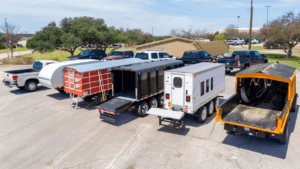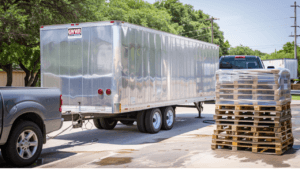

You found a trailer you want to rent — maybe a car hauler to move a project truck, a deckover with mega ramps to haul your Bobcat to a job in Bastrop, or a hydraulic dump trailer to move ten yards of topsoil to a new build in Pflugerville. You’ve got a half-ton pickup or a mid-size SUV sitting in the driveway. Now the real question: can it actually handle the load?
The short answer is “probably yes — but not necessarily the way the sticker on the window suggests.” Manufacturer tow ratings are real, but they come with a wall of fine print. Austin drivers face extra considerations: Mopac and I-35 merge traffic means sudden braking events, the Y at Oak Hill puts you into a sustained grade before you even leave the metro, and climbing 290 west toward Dripping Springs with a loaded trailer tests every component in your tow setup. This guide cuts through the marketing numbers and tells you what your specific truck or SUV can actually do — safely, legally, and in the real Austin driving environment.
The Number Everyone Reads First — and Why It Is Not the Full Story
Every truck manufacturer publishes a maximum tow rating: 13,500 lbs, 12,000 lbs, 11,570 lbs. Those numbers live on window stickers, in commercial ads, and in comparison articles. What those sources rarely say loudly enough is the phrase “when properly equipped.”
“When properly equipped” can mean:
- The specific turbocharged or high-displacement engine option
- A factory-installed Max Tow Package (upgraded hitch receiver, longer wheelbase, upgraded radiator and transmission cooler)
- A specific rear-axle ratio (3.73 or higher, sometimes only available on 4×2 configurations)
- No passengers and no cargo in the truck bed
A base-trim F-150 with the 2.7L EcoBoost and a 3.55 axle ratio is rated for roughly 8,400 lbs — not 13,500. A Tundra SR base model lands around 8,300 lbs. These are still impressive numbers, but they matter because trailer rental decisions need to be made against your truck’s actual configuration, not the billboard figure.
The fix: Check the door-pillar sticker on your truck. It lists your truck’s specific GVWR. Cross-reference your owner’s manual or the manufacturer’s tow guide PDF for your engine and package combination. If you do not know your truck’s rated tow capacity, do not assume it is the maximum advertised figure.
The Payload Problem — Why Most Renters Are Closer to Their Limit Than They Think
Tow rating gets the headlines. Payload capacity is the number that actually bites people.
Payload is the total weight your truck can carry — passengers, cargo in the bed, and tongue weight from the trailer. It is not the tow rating. It is a separate, often much lower number printed on the door sticker.
Here is why it matters in practice: the tongue of a loaded trailer typically pushes down on the hitch ball with 10–15% of the total loaded trailer weight. That force registers against your truck’s payload.
Example: You rent a 7,000-lb loaded car hauler. Tongue weight at 12% = 840 lbs. You have two adults in the cab (400 lbs combined) and 100 lbs of gear in the back seat. That is 1,340 lbs against your payload before you add anything to the bed. If your truck’s door sticker says 1,500-lb payload, you are 160 lbs from the legal limit with an empty bed — and you have not started loading tools.
Most stock half-ton trucks — even well-optioned ones — have real-world payload figures between 1,500 and 2,000 lbs. A few high-spec configurations (F-150 with the 3.5L EcoBoost and Max Payload Package, some Silverado 1500 Heavy Duty trim versions) push toward 2,200 lbs. That headroom disappears quickly when passengers, tools, and tongue weight are factored in.
The practical rule: Know your payload number before you book a trailer. You can find it on the yellow sticker inside the driver’s door jamb. It is the single most important number for a loaded rental tow.
Austin-Specific Towing Reality: Grades, Traffic, and the Y at Oak Hill
Towing in Austin is not flat-highway cruising. Consider three real scenarios:
Scenario 1 — Tarrytown to Pflugerville via Mopac and 183. You have a utility trailer loaded with furniture from a garage cleanout. Mopac merge points and the Barton Skyway interchange require hard braking. Even at highway speeds, a properly secured and brake-equipped trailer stops cleanly. Without trailer brakes — meaning a trailer whose gross weight puts it over 4,500 lbs loaded — Texas law requires brakes on that trailer. More on that in the law section below.
Scenario 2 — South Austin to a job site near Dripping Springs via 290 West. The long grades climbing out of the Barton Creek greenbelt area and continuing through Oak Hill onto 290 put sustained load on the tow vehicle’s drivetrain and transmission. Heat buildup in the transmission fluid is a real risk on long grades with a heavy trailer. Use tow/haul mode. Downshift on descents rather than riding the brakes.
Scenario 3 — Hyde Park to a ranch in Bastrop County via 183 to 71. Flat route, but the distance means sustained highway speed. Wind buffeting is your enemy on an open trailer with an asymmetric load. Balance the load front-to-back (60% in front of the axle) and side-to-side.
The Hill Country grades — whether you are going out RM 2222 to 620 toward Lakeway or heading out 290 toward Dripping Springs — demand honest adherence to your truck’s ratings. This is not the I-10 panhandle. Sustained 4–6% grades over several miles are a different challenge than flat urban hauling.
Tow Vehicle Comparison Table — Real Austin Truck and SUV Choices
The figures below are published 2024–2025 manufacturer maximums for the best-equipped configuration of each model. Your specific vehicle may be rated significantly lower. Always verify against your door sticker and owner’s manual.
| Vehicle | Engine (Best Config) | Max Tow Rating | Typical Real-World Payload | Hitch Class (Stock) | Notes |
| Ford F-150 | 3.5L EcoBoost + Max Tow Pkg | 13,500 lbs | ~1,800–2,000 lbs | Class IV | Max tow requires specific config; base 2.7L rates ~8,400 lbs |
| Chevy Silverado 1500 | 6.2L V8 + NHT pkg | 13,300 lbs | ~1,700–2,000 lbs | Class IV | NHT = National Highway Towing; base 2.7L Turbo ~9,300 lbs |
| Ram 1500 | 3.0L Hurricane I6 | 11,570 lbs | ~1,600–1,900 lbs | Class IV | 3.6L Pentastar V6 rates ~8,110 lbs; check trim carefully |
| Toyota Tundra | i-FORCE 3.4L Twin-Turbo V6 | 12,000 lbs | ~1,600–1,900 lbs | Class IV | SR base ~8,300 lbs; 4×4 and short bed reduce rating |
| Toyota Tacoma | 2.4L Turbo i-FORCE (2024+) | 6,500 lbs | ~1,200–1,440 lbs | Class III | Mid-size; good for utility trailer, light dump loads |
| Chevy Colorado | 2.7L Turbo High-Output | 7,700 lbs | ~1,300–1,500 lbs | Class III | Segment leader; still a mid-size — verify your specific trim |
| Toyota 4Runner | 4.0L V6 | 5,000 lbs | ~1,000–1,200 lbs | Class III | Rated for lighter utility or enclosed trailer; not for heavy equipment |
| Chevy Tahoe / Suburban | 5.3L V8 (Max Trailering) | 8,400 lbs | ~1,500–1,700 lbs | Class IV | Suburban adds rear-seat weight; always deduct passenger weight from payload |
| Ford Expedition | 3.5L EcoBoost (Max Tow) | 9,300 lbs | ~1,600–1,850 lbs | Class IV | Full-size SUV; legitimately capable but passenger load eats payload fast |
Sources: 2025 Ford F-150 Towing Guide, 2025 Ram 1500 Towing Guide, GM Authority 2024 Silverado 1500 Towing Capacities, 355 Toyota Tundra Towing Capacity
Key takeaways from the table:
- The F-150, Silverado 1500, Ram 1500, and Tundra can all legally tow most rental trailers — including car haulers and equipment trailers — but only if the trailer’s GVWR does not exceed the truck’s specific rating and the tongue weight fits within the truck’s remaining payload.
- Mid-size pickups (Tacoma, Colorado) are excellent for utility trailers, light dump loads, and single ATV hauls, but fall short for heavy equipment trailers rated above 7,000 lbs.
- SUVs (4Runner, Tahoe, Expedition) can tow meaningfully but passenger loads eat into payload fast. A Tahoe with three adults and luggage may have only 700–800 lbs of payload headroom remaining — not enough tongue weight for a fully loaded 6,000-lb trailer.
Hitch Class: What’s Actually on Your Truck
Most full-size trucks and large SUVs leave the factory with a Class III or Class IV hitch receiver. Here is what those ratings mean in practice:
- Class III (2″ receiver): Up to 8,000 lbs GTW (Gross Trailer Weight) in weight-carrying mode. Handles the vast majority of rental trailers — utility trailers, enclosed cargo, light car haulers.
- Class IV (2″ receiver): Up to 10,000 lbs GTW. Found on properly equipped half-tons. Adds margin for heavier equipment trailers.
- Class V (2″ or 2.5″ receiver): 16,000–20,000 lbs GTW. Found on 3/4-ton and 1-ton trucks. Needed for the heaviest deckover loads.
The hitch capacity is always capped by the tow vehicle’s own rated capacity — the lower number governs. If your truck is rated for 8,000 lbs but has a Class IV hitch, you still cannot legally or safely exceed 8,000 lbs GTW.
Mid-size trucks (Tacoma, Colorado) typically come with Class III hitches rated between 5,000 and 8,000 lbs depending on configuration — consistent with their tow ratings.
Texas Towing Law Callout: Brakes, Brake Controllers, and Your License
Brake requirement — §547.401: Under Texas Transportation Code §547.401, a trailer must be equipped with brakes if its gross weight exceeds 4,500 lbs and it is towed above 30 mph. On any Austin highway — Mopac, I-35, 290, 183, 71, 130 — you will be above 30 mph. That means any trailer loaded above 4,500 lbs total needs functional brakes.
Electric brake controller: If your rental trailer uses electric brakes (standard on most equipment and car hauler trailers above 4,500 lbs), those brakes do absolutely nothing without an electric brake controller mounted in your cab. Texas does not have a separate statute naming the controller specifically, but §547.402 requires that brakes operate — and electric brakes cannot operate without a controller. Make sure your truck has one installed before you hook up.
License class — §521.081: Your standard Class C driver’s license is sufficient for virtually every rental scenario with a half-ton truck. A Class A non-commercial license is only required when your Gross Combined Weight Rating (GCWR — truck plus trailer combined) reaches 26,001 lbs or more AND the trailer’s GVWR exceeds 10,000 lbs. An F-150 (GVWR ~7,000 lbs) pulling a 14,000-lb GVWR deckover has a GCWR of ~21,000 lbs — still under the threshold. You would need to be pulling an extremely heavy trailer with a heavy-duty truck to trigger Class A requirements.
Safety inspection update — HB 3297: As of January 1, 2025, non-commercial trailers in Texas no longer require an annual safety inspection before registration renewal. Governor Abbott signed HB 3297 in 2023, and the Texas DPS confirmed it took effect January 1, 2025. The trailer you rent is still required to be registered and properly equipped — but the annual sticker requirement is gone for non-commercial equipment.
Which Texas Pro Trailers Trailer Matches Your Rig?
Use this as a quick-match guide:
Half-ton truck (F-150, Silverado 1500, Ram 1500, Tundra) — well equipped:
- Utility trailer: Easy. Rated well within range.
- Enclosed cargo trailer: Easy.
- Car and equipment hauler: Yes, with a fully loaded GVWR typically under 10,000 lbs — verify your specific truck config.
- Hydraulic dump trailer: Yes — but watch payload. A loaded dump trailer’s tongue weight can be significant. A 14-ft hydraulic dump loaded with topsoil can gross well over 10,000 lbs. Match the math before you haul.
- Full-tilt deckover: Check your specific rating. A 14,000-lb GVWR deckover is within range for a properly equipped F-150 3.5L EcoBoost but at the edge. Confirm your truck’s rating.
- Deckover with mega ramps: Same guidance as full-tilt deckover.
Mid-size truck (Tacoma, Colorado):
- Utility trailer: Yes.
- Enclosed cargo trailer (lighter loads): Yes.
- Car and equipment hauler: Light-to-moderate loads only. Check GVWR against your truck’s rating.
- Dump trailer, deckover: Generally not recommended unless load is intentionally kept well under the trailer’s GVWR and within the truck’s tow rating.
Large SUV (Expedition, Tahoe/Suburban):
- Utility trailer, enclosed cargo trailer: Yes.
- Car and equipment hauler: Possible for lighter configurations, but passenger load must be factored into payload.
- Deckover, dump trailer: Not recommended for heavy loads. Deduct passenger and gear weight from payload before calculating tongue weight headroom.
Compact SUV / 4Runner:
- Utility trailer (light loads): Yes.
- Anything heavier than 5,000 lbs GTW: Verify carefully or choose a smaller load.
The Driveway Test — Can You Actually Back That Trailer In?
This one matters in Tarrytown and Hyde Park, where driveways are narrow and live oaks line the curb. A longer trailer (20-ft car hauler, 18-ft deckover) in a tight residential setting requires practice backing. If you have never backed a trailer, the Texas Pro Trailers 24/7 lot at 7511 Dee Gabriel Collins Rd gives you a wide open approach to practice before you head into a residential neighborhood.
Soft CTA
If you are ready to match your truck to the right trailer, Texas Pro Trailers has the fleet ready to go whenever you are — no staff to wait on, no phone calls, no business hours to beat. Book online at texasprotrailers.com, get your PIN, and pull out from 7511 Dee Gabriel Collins Rd on your schedule. Not sure which trailer fits your tow vehicle? The trailer overview page lists GVWR and specs for every unit in the fleet.