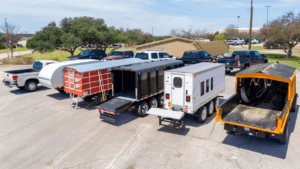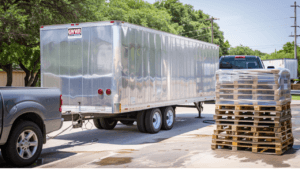

If you have ever tried to load a skid steer onto a standard flatbed and watched the bucket just barely squeeze past the fender wells, you already understand the problem a deckover trailer solves. If you have never loaded heavy equipment before and someone told you to “just get a deckover,” this guide will tell you exactly what that means, why the design exists, and whether your specific job actually calls for one.
The short version: a deckover trailer positions its deck above the wheel axles rather than between them. That single design decision gives you a flat, full-width loading surface from one side of the trailer to the other — no fender humps, no wheel wells eating into your usable width. For anything wide — a skid steer, a mini excavator, a pair of golf carts, a race car on a rolling stand — that full-width deck is not a luxury. It is a functional requirement.
How a Deckover Is Different from a Standard Flatbed
Most utility trailers, car haulers, and equipment trailers are built with the deck sitting between the wheel fender wells. The wheels extend out to the sides, and the usable deck width is narrower than the trailer’s overall width. A 102-inch-wide trailer might have an effective deck width of 80–83 inches between the fenders.
A deckover flips that geometry. The axles and wheels are positioned below and outside the frame. The deck sits on top, spanning the full width of the trailer. That means a 102-inch-wide deckover has 102 inches — the full 8’6″ legal maximum under Texas Transportation Code §621.201 — of usable deck width from edge to edge.
Why 102 inches matters: Under §621.201, the total width of a vehicle or load on Texas roads cannot exceed 102 inches without a permit. A deckover trailer at full legal width is already at that limit — meaning you can legally load the widest machine that fits on the trailer and still operate on any Texas highway without an oversize load permit.
That matters when you are hauling a 96-inch-wide skid steer from a South Austin storage yard out to a Bastrop County job site on FM 969. It matters when you are loading an 84-inch-wide Kubota compact track loader in a Pflugerville equipment yard and driving it to a new build near Manor. It matters when you are moving a wide-body sports car from your garage in Tarrytown to Circuit of the Americas for a track day.
The Two Types of Deckover at Texas Pro Trailers
Not all deckovers are the same. Texas Pro Trailers keeps two distinct variants in the fleet, and the difference between them is not cosmetic — it determines which jobs each trailer is right for.
Full-Tilt Deckover
A full-tilt deckover has no ramps at all. The entire deck hydraulically or mechanically tilts toward the ground at the rear, creating a gradual loading ramp with the deck itself. The load drives or rides directly onto the tilted surface and the deck then returns to level once loaded.
The design advantage: Eliminates ramp angle entirely. There is no ramp-to-deck transition point where a low-clearance machine can hang up. The loading angle is gentler and more consistent than even the best removable ramps.
Best use cases for the full-tilt deckover:
- Compact tractors and riding mowers with low undercarriage clearance — A sharp ramp angle can catch the belly pan or mowing deck. The tilt eliminates this.
- Low-profile equipment on rubber tracks — Any machine with minimal ground clearance that would bottom out on traditional ramp angles.
- Solo loading situations — Tilt loading requires no one to manage ramp positioning or alignment. One person can load unassisted.
- Situations where speed matters — No ramp setup, no ramp breakdown. Hook up, tilt, load, level, go.
Deckover with Mega Ramps
The deckover with mega ramps keeps the deck at a fixed, level height and uses extra-wide, heavy-duty loading ramps to bridge from the ground to the deck surface.
The difference from standard ramps is the width. Mega ramps are wide enough to accommodate both tracks or both tires of a full-width machine simultaneously, without the machine’s tracks or wheels bridging between a narrow ramp and the fender well edge.
The design advantage: Full-width ramp contact means the machine never has to balance a track between a ramp and the deck edge. Every inch of the machine’s footprint lands on solid ramp or solid deck during the entire transition.
Best use cases for the deckover with mega ramps:
- Full-size skid steers and track loaders — Machines like a Bobcat S740 or a Case SR250 can be 72–76 inches wide at the tracks. Mega ramps handle the full width cleanly.
- Mini excavators being driven on their undercarriage — The machine transitions smoothly without the boom swinging into tight spaces.
- Golf carts loaded in pairs — Two golf carts side by side can fit on a full-width 102-inch deck. Mega ramps make loading either cart a straight-line drive without fender-pinch anxiety.
- Any machine where driving precision during loading is limited — Wide ramps are more forgiving of minor steering input during the load.
Real Austin Use Cases: Who Rents a Deckover and Why
Construction and Equipment Hauling — Bastrop, Manor, and the Eastern Growth Corridor
The fastest-growing parts of the Austin metro are to the east — Bastrop County, Manor, and the Highway 290 East and FM 969 corridors. Samsung’s semiconductor fab in Taylor, new subdivisions from Manor to Elgin, and Bastrop County’s recovery and new construction have created sustained demand for equipment hauling across routes that do not always have nearby rental depots.
A contractor running a Bobcat skid steer and a mini excavator between jobs along the 290 East corridor needs a trailer that handles both machines. The deckover with mega ramps accommodates the skid steer’s width and the mini excavator’s undercarriage without requiring separate hauls. One rental, one trip, one keypad pickup at 7511 Dee Gabriel Collins Rd — any hour of the day or night before an early job start.
F1 Race Car Transport to COTA
The Circuit of the Americas at the southern end of the metro hosts the Formula 1 United States Grand Prix in October, alongside multiple club racing and track day events throughout the year. Participants transporting a race car on a rolling stand or frame jig — or moving a wide-body track car with aftermarket wide-body aero — need a flat, wide, low-drama loading surface.
A full-tilt deckover handles this cleanly. No ramp transition to navigate with a car on a trailer dolly. No fender well to clear with aftermarket bodywork. The deck tilts, the car rolls on, the deck levels. The combined length stays within the 65-foot limit under Texas Transportation Code §621.204.
Golf Cart Hauling for Events and Properties
Austin-area event venues, resorts on Lake Travis, lakefront properties in Lakeway, and large properties throughout the Hill Country routinely move golf carts between storage and event locations. Two standard golf carts side by side run approximately 8 feet wide combined — fitting on a 102-inch deckover deck with clearance for tie-down strap work.
Neither golf cart will load cleanly on a standard flatbed with wheel fender wells in the way. A deckover — either the full-tilt or the mega-ramp variant — handles the pair in one trip.
Texas Towing Law Callout: Width, Length, and What You Need to Drive It
Width — §621.201: Texas Transportation Code §621.201 sets the maximum vehicle width at 102 inches. A deckover trailer at its full 8’6″ deck width is legal on every Texas highway without a permit, as long as the load itself does not extend beyond the deck edges. Loads that overhang the side of the trailer push you into oversize load permit territory. Most equipment — skid steers, excavators, golf carts — fits within the deck width.
Combined length — §621.204–§621.206: A truck-and-trailer combination in Texas cannot exceed 65 feet in total length without a permit. A standard full-size pickup (approximately 19–21 feet) plus a 20-foot deckover trailer puts the combination at roughly 39–41 feet — well inside the 65-foot limit.
Height — TxDMV: Maximum legal height is 14 feet. A deckover sits higher than a standard trailer because the deck is elevated above the axles. A machine loaded on a deckover stands taller than it would on a low-profile trailer. Know your loaded height before you go under a bridge on FM roads or inside gated properties.
Brakes — §547.401: Under Texas Transportation Code §547.401, brakes are required on a trailer whose gross weight exceeds 4,500 lbs. A 14,000-lb GVWR deckover with any meaningful equipment load will far exceed that threshold. The trailer’s brakes must be functional and your tow vehicle must have an electric brake controller installed and calibrated. There is no safe workaround for this requirement on a machine this size.
License — §521.081: Your standard Class C driver’s license covers towing a deckover trailer with most 3/4-ton and 1-ton trucks. A Class A non-commercial license is required only when the gross combination weight rating of the truck and trailer together reaches 26,001 lbs or more AND the trailer’s GVWR exceeds 10,000 lbs. A 14,000-lb GVWR deckover paired with a 3/4-ton truck (GVWR approximately 8,600–9,900 lbs) gives a GCWR in the 22,600–23,900 lb range — still below the Class A threshold. Pair a 14,000-lb trailer with a 1-ton dually (GVWR around 11,500–13,000 lbs) and the combined GCWR starts approaching that 26,001-lb trigger — worth calculating before you hook up.
What Truck Do You Need for a Deckover?
A full-tilt deckover or deckover with mega ramps at 14,000 lbs GVWR is not a half-ton trailer for light loads. You can tow a lightly loaded deckover with a well-equipped half-ton truck — an F-150 with the 3.5L EcoBoost, properly rated for up to 13,500 lbs — but the margin disappears fast once you start loading equipment.
For anything approaching the trailer’s full capacity, a 3/4-ton truck (Silverado 2500HD, Ram 2500, F-250, Tundra in heavy configurations) or a 1-ton truck is the appropriate tow vehicle. These platforms offer:
- Higher GVWR (up to 10,000+ lbs) that keeps the GCWR calculation manageable
- Greater payload capacity to absorb tongue weight from a heavy trailer
- Factory-spec brake controllers and upgraded cooling systems
- Class V hitch receivers rated for the full tongue weight of a loaded deckover
If you are renting a deckover to haul a skid steer or mini excavator and your tow vehicle is a half-ton, do the math before you book. Calculate: (trailer GVWR) + (tow vehicle GVWR) against the 26,001-lb license threshold. Then calculate: (estimated tongue weight of loaded trailer, ~12% of loaded gross) against your truck’s remaining payload after passengers and gear.
Deckover vs. Standard Flatbed: Quick Decision Guide
| Situation | Deckover? | Standard Flatbed? |
| Load wider than 83 inches | Yes — deckover | No |
| Skid steer or track loader | Yes — deckover | Risky; fender pinch points |
| Single ATV or UTV under 72″ wide | Either works | Yes |
| Golf carts (2 side by side) | Yes — deckover | No |
| Mini excavator on undercarriage | Yes — deckover | Depends on width |
| Race car or wide-body vehicle | Yes — deckover | Possibly, check width |
| Lumber, pipe, or building materials | Either works | Yes — simpler, lower profile |
| Low-clearance compact tractor | Yes — full-tilt deckover | Risky ramp angle |
| Car with ground effects or low splitter | Yes — full-tilt deckover | Risky ramp angle |
Soft CTA
If your job calls for a wide-load hauler, Texas Pro Trailers keeps both the full-tilt deckover and the deckover with mega ramps on the lot at 7511 Dee Gabriel Collins Rd — available any hour, any day, with no staff required. Book online, get your PIN, and load up whenever the job schedule demands it. Not sure which variant fits your machine? The deckover trailer page and the mega ramps page list full specs for both.