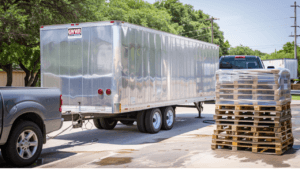

Archery season opens in early October and the general white-tailed season opens the first Saturday of November, which means the next few weekends are when Central Texas hunters haul everything to the lease at once: feeders, corn, blinds, a side-by-side, water, lumber for the stand that finally gave up. Most of it doesn’t fit in a truck bed. Here’s which trailer to grab for which job, and how to get it there without losing anything on 290.
Match the trailer to the load
Feeders, corn, protein, and lumber → 16′ utility trailer. A gravity or spin feeder is bulky but not heavy, and a pallet of corn or protein is heavy but compact. The 16′ utility handles both with room to spare, and the rear ramp gate means you roll the feeder on instead of lifting it. Strap the feeder legs down; a tall feeder with a full barrel catches wind like a sail.
ATV, UTV, or side-by-side → 20′ car & equipment hauler. This is the trailer for the machine. Drive on, strap the frame at four points, and you’ve still got deck room ahead of it for coolers and gear. If the machine won’t start, the front-mounted electric winch pulls it on. Fair warning: the hauler has electric brakes, so read the brake controller note below before you book it.
Machine plus a box blind or tower stand → 24′ full-tilt deckover. When the load is a UTV and a 6×6 box blind, you want length and a deck with no fenders in the way. The tilt deck lets you load the blind without a ramp. Put the heavy machine over the axles and the blind behind it, and check tongue weight before you leave (more on that below).
Keeping gear dry and out of sight → 20′ enclosed cargo. Rifles, optics, camp gear, and a weekend of groceries ride better behind a locked door. D-rings run the length of both walls, so a small ATV fits in here too.
Lease road work → 14′ hydraulic dump. Road base, caliche, gravel for the low-water crossing, or a season’s worth of brush cleanup. Load it forward, tarp it (Texas law for loose material), and dump on level ground.
Loading the lease trailer without it swaying
Hunting loads are the classic recipe for trailer sway: a heavy machine, a tall light feeder, and a pile of odd shapes. Three rules cover almost all of it:
- Heavy stuff forward. About 60% of the weight ahead of the axles. A UTV loaded at the back of the deck will fishtail at highway speed.
- Strap every single thing. Four points on the machine, to the frame or tie-down loops, never the suspension. Feeders and blinds get ratchet straps, not bungees. Corn bags get a tarp over them.
- Re-check at the first stop. Straps loosen in the first 15 minutes. Tug them all when you stop for fuel or breakfast tacos.
The full version is in our Packing and Securing Your Load and Loading and Unloading guides.
The brake controller question
Our 16′ utilities and the 20′ enclosed trailer tow behind anything with a hitch. The car hauler, tilt, and dump have electric brakes, which means your truck needs a brake controller — or you use the Elecbrakes app on your phone, which comes with those trailers and needs nothing installed in your truck. We wrote up exactly how that works in Do You Need a Brake Controller to Rent a Trailer?.
Driving it out there
- Leave early, drive a little slower. Loaded, you want 5–10 mph under the limit, especially on the two-lane roads past the last Buc-ee’s.
- Check the lights before dark. You’ll be coming home after sunset on Sunday. Cycle the lights before you leave the lease.
- Lease roads shake things loose. Walk around the trailer when you get back to pavement and tug the straps again.
- Know the size of your gate. A 24′ deckover plus a truck needs room to swing through a ranch gate. Take the long way around the turn.
Why the 4 a.m. pickup matters
Opening weekend traffic on I-35 and 290 is real. Our yard is self-service and open 24/7: book online, get your PIN, and pick up at 4 a.m. Friday so you’re on the lease by sunrise. Return whenever you get back, day or night, and the price is by the day, so a Friday-to-Sunday trip is three days, not a weekend surcharge.
See the fleet and book · Driving With a Trailer · Trailer Safety Checklist · Electric Winch Guide